EN


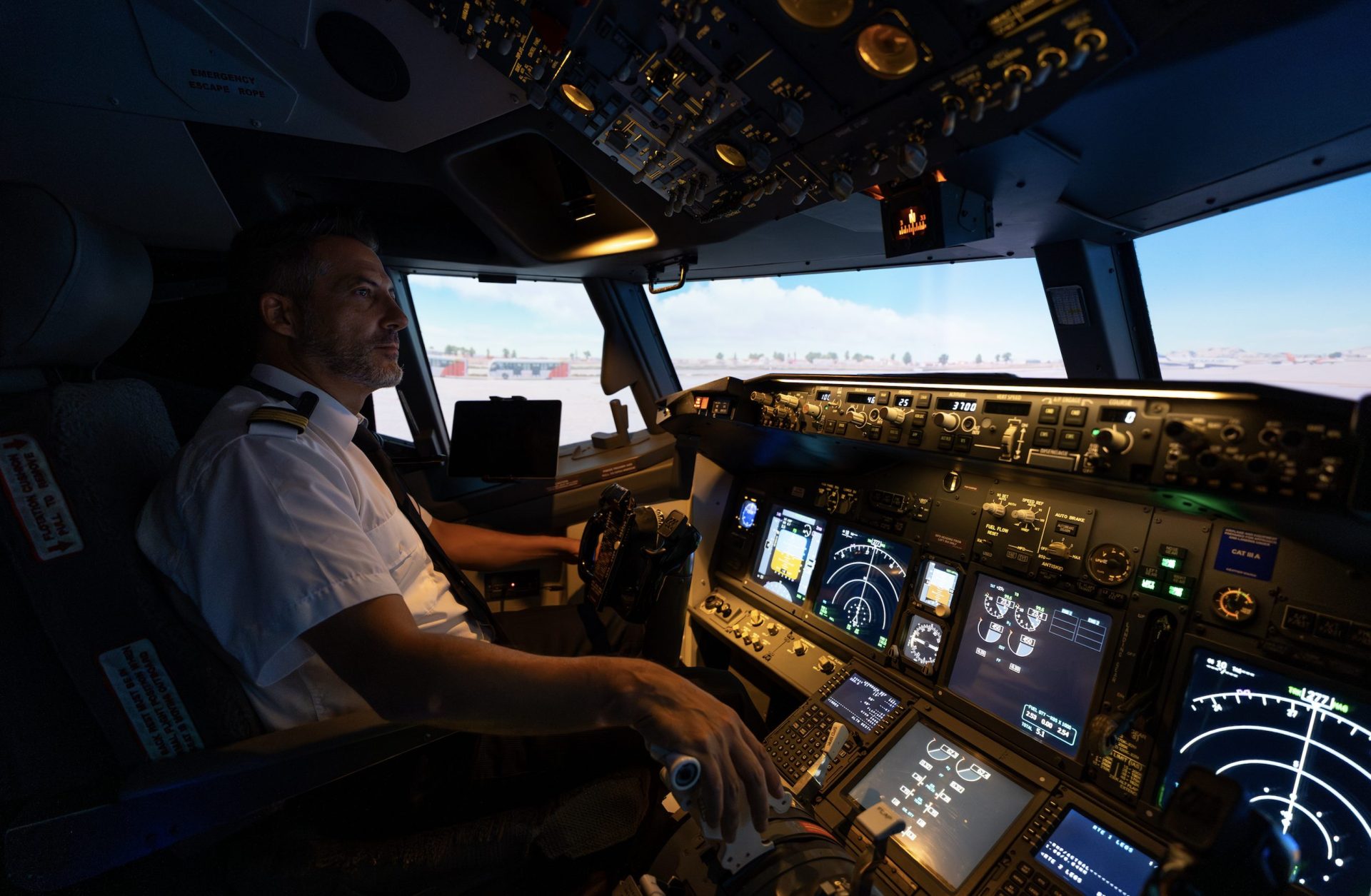
Completing a simulator exercise is not always the same as demonstrating the competency it was designed to assess.
Imagine two trainees facing the same developing problem. One detects it by regularly checking the relevant instruments. The other responds only after an alert directs their attention to it. Both handle the event successfully, so their outcomes may look much the same. But if proactive monitoring is one of the required behaviors, did both trainees demonstrate the required performance – or did the scenario allow one of them to succeed without it?
That distinction lies at the heart of competency-based training (CBT), generally described in aviation as competency-based training and assessment (CBTA). It focuses on demonstrated performance, not task completion alone.
For training teams, this creates two connected questions: can the assessment distinguish between what the two trainees demonstrated, and did the scenario actually require the behavior the competency was designed to test? Answering them requires a closer look at how each trainee gathered visual information as the scenario unfolded.
Competency-based approaches and virtual training are developing in parallel. In June 2026, EASA introduced CBTA-based performance standards for initial air traffic controller training. The same decision also enabled greater use of virtualized training. This brings two important parts of training design closer together: what the trainee is expected to demonstrate and the environment in which that performance is observed.
The same priorities are visible across the industry. APATS 2026 is dedicating a session to taking competency-based training beyond compliance, while I/ITSEC 2026 is seeking work on CBTA, training-system evaluation and evidence of effectiveness throughout the system lifecycle. Together, these developments make the simulated environment part of the assessment – not simply the place where training happens.
Competency-based training begins by defining what successful performance looks like. In ICAO’s CBTA framework, each competency is linked to observable behaviors, the conditions in which they should be demonstrated, and the standards trainees must meet. In a simulator-based assessment, this means looking beyond whether the trainee achieved the right outcome to examine the behaviors that led to it.
Consider a pilot managing a developing system failure. Simulator data can record which actions were taken, when the pilot responded and whether the aircraft remained within safe operating limits.But if the competency also involves monitoring and information gathering, the eventual response tells only part of the story.
This is where eye tracking adds another source of evidence. Gaze data can show where the pilot looked across the flight displays, engine indications and alerts as the situation developed. Combined with simulator data and instructor observations, it gives training teams a clearer view of both what the pilot did and how they gathered the visual information needed to act.
Eye tracking can therefore strengthen the assessment of the trainee. But the same evidence can also be used to examine the simulator itself: did the scenario create the right attention demands in the first place?
For trainees to demonstrate the required behaviors, the simulator must give them a meaningful opportunity to do so. Detailed visuals, realistic controls and accurate system responses can make the environment feel credible, but they do not guarantee that the scenario recreates the demands of the real task. If the competency involves monitoring and information gathering, the simulator must require operators to find and monitor the right information at the right time.
Researchers describe this as psychological fidelity: how closely a simulation recreates the perceptual and cognitive demands of the real task. When monitoring and information gathering are central to the task, gaze data can help teams put the simulation’s attention demands to the test.
For example, eye tracking can show whether critical cues attract attention as intended and whether operators continue to monitor relevant displays as the scenario develops. It can also reveal differences in how experienced and less-experienced operators approach the task, or unexpected monitoring behavior following a change to the scenario or interface.
If the resulting patterns differ from what procedures or experienced operators would lead teams to expect, the scenario may warrant closer investigation. Training teams can then refine its cues, displays or design before using it as the basis for training and assessment.
A flight simulation study shows what this can look like in practice. Researchers asked 18 airline pilots with different levels of experience to complete a series of training exercises in VR. If the simulation recreated relevant demands of real flying, greater real-world experience should be reflected in how the pilots performed inside it.
Those differences appeared most clearly in the gaze data. More experienced pilots showed fewer, longer fixations and more structured, less-random scan paths. The flight trainer’s performance ratings, by contrast, showed little relationship with the pilots’ real-world experience. The researchers concluded that the existing assessment criteria were not sensitive enough to capture these differences.
Together, the results showed two things. First, the experience-related gaze patterns suggested that the simulation recreated meaningful demands of real flying, supporting its construct validity and psychological fidelity. Second, eye tracking revealed differences that the performance ratings did not capture. For training teams, this shows how gaze data can help test both the simulation and the criteria used to assess performance within it.
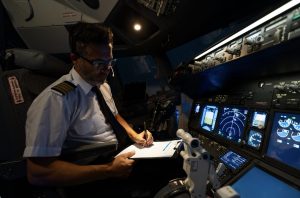
Gaze data becomes useful evidence when it is connected to a specific competency and scenario. Training teams can do this in four stages.
This extends the value of eye tracking beyond individual debriefs, making it a resource for evaluating and improving the training system itself.
To support all of these uses, eye tracking must fit naturally into both the simulator and the instructor’s workflow. Smart Eye’s remote eye tracking uses cameras mounted within the simulator, capturing gaze without interrupting training or requiring wearable equipment.
Once the relevant instruments and displays have been modeled, gaze can be mapped to them and synchronized with simulator events and existing analysis tools. The same recording can then support several parts of the training process: reviewing individual performance, guiding instructor-led debriefing and examining whether the scenario elicited the intended behavior.
EyeTracking, a Smart Eye partner, provides a practical pilot-training example of how eye tracking can fit into the training workflow. Its PilotReady solution integrates with existing training systems, supporting scan-pattern visualization, event replay and performance comparison.
Competency-based training asks whether a trainee demonstrated the required performance. Eye tracking can help answer that question – and prompt a broader one: did the simulator create the right conditions for the required visual behaviors to appear, and did the assessment capture them? Bringing that evidence together provides a stronger basis for evaluating not only the trainee, but the training system itself.
Learn more about integrating eye tracking into an existing simulator, or contact Smart Eye to discuss your training environment.