EN


Designing a good eye tracking study means planning for the unexpected. But one factor often gets less attention than it deserves: the participants themselves.
Not just how many, or how long they’ll be in the lab, but who they are. Are they children or older adults? Wearing glasses? Eye makeup? Do their facial features fall outside what most tracking systems were trained on?
In an ideal world, those differences wouldn’t affect results. But no system is perfect – and if yours isn’t built to handle diverse populations, you’ll see it in the data.
In this blog, we’ll look at why participant variation can present issues, which factors are most likely to interfere with tracking, and how to build a setup that works across the range of people you actually want to study.
Infrared-based eye tracking systems depend on a pretty simple idea: they detect the pupil and corneal reflection, then calculate gaze direction based on that geometry.
But in practice, that process depends on clear, unobstructed, and consistent detection – and that’s where things can start to break down.
Glasses with strong prescriptions or anti-reflective coatings can distort or obscure the corneal reflection. Heavy eyeliner or certain eye shapes can make the pupil harder to segment. Facial geometry – like deep-set eyes, epicanthic folds, or asymmetric features – can throw off assumptions baked into the system’s algorithms or camera placement.
In short: anything that interferes with how the system “sees” the eye can compromise accuracy.
Many eye trackers are validated under ideal lab conditions, with controlled lighting, cooperative participants, and often a fairly narrow range of facial characteristics. But real-world research doesn’t work like that. Most studies aim to include a wide range of participants, either by design or necessity. And if your system cannot accommodate for certain groups, you’re introducing systematic bias.
This can skew your results, limit who you’re able to recruit, or force you to discard data from participants who don’t “fit” the system – none of which make for strong or representative science.
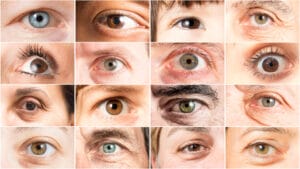
Real-world participants bring all kinds of variation, and certain factors are consistently harder to track. These are the ones that show up again and again in both academic research and hands-on lab work:
Glasses and Contact Lenses
Glasses are a well-known source of tracking issues, but they remain a common pain point in many studies.
• Reflective, tinted, or anti-glare coatings can distort or block the corneal reflection.
• Some systems lose track entirely depending on lens angle or lighting.
• Contact lenses tend to cause fewer problems, but can still affect calibration in some setups.
Eye Makeup and Facial Accessories
Makeup around the eyes – especially glitter, heavy eyeliner, or false lashes – can interfere with both pupil detection and segmentation.
• Thick eyeliner can reduce contrast around the pupil.
• Glitter or shimmer reflects infrared light, introducing noise.
• False lashes or lash extensions can obscure parts of the eye.
Because makeup use often correlates with gender, age, or cultural background, these issues can also introduce unintentional demographic bias into the data.
Ethnic Diversity and Facial Geometry
Some systems perform inconsistently across different ethnic groups, often due to differences in facial structure, eye anatomy, or skin tone.
• Deep-set eyes, epicanthic folds, and wide facial spacing can challenge default camera placements.
• Depending on system design, low contrast in facial features or eye region – especially with darker irises or skin tones – can affect detection in some setups, though many modern systems have improved in this area.
• Many tracking systems were trained or validated on limited datasets, reducing generalizability.
Academic awareness of these limitations is growing, particularly in fields focused on AI fairness and bias. But in many labs, they remain under-addressed in study design.
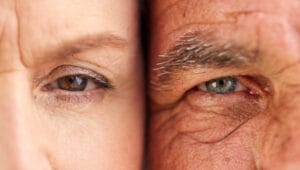
Age-Related Differences
Age can impact tracking in multiple ways. Not only due to physical differences, but also behavioral ones.
• Children: Smaller facial features and shorter attention spans often require minimal calibration and more flexible setups.
• Older adults: May have drooping eyelids, reduced gaze range, or age-related eye conditions that affect tracking stability.
Fixed-position setups, like simulators or multi-camera rigs, may struggle to accommodate these variations without custom adjustments.
Not every participant will calibrate perfectly on the first try. And that’s fine, as long as your setup is designed to adapt.
If your study includes children, older adults, or a demographically diverse group, you’ll need more than a one-size-fits-all solution. These strategies can help minimize data loss and make your study more inclusive from the start:
Flexible Calibration Options
Standard 5- or 9-point calibrations can be difficult for some participants, especially kids or anyone with limited mobility or attention. Alternatives like one-point calibration, pursuit calibration, or guided fixation techniques can get the job done with less friction.
Validation Protocols
A calibration that looks good on screen doesn’t always translate to real-world accuracy. Build in frequent validation checks – not just once at the start, but throughout the session – to spot drifting or degraded tracking before it derails your data.
Custom Profiles
If your software allows it, preload known information about the participant (e.g., glasses, eye color, seating needs). The extra effort is minimal, but it can make a big difference in stability and speed of calibration.
Multi-Camera Setups
Adding extra angles improves coverage, particularly for participants with facial features that fall outside typical configurations. This is especially helpful in setups like simulators or cockpits, where head position is less predictable.
Participant Prep
A quick glasses cleaning, adjusting the seat height, or minimizing reflective makeup (if the participant is comfortable doing so) can improve tracking without compromising participant comfort or autonomy.
Some tracking issues can be worked around. Others can’t, at least not with technique alone.
If your system struggles to detect certain eyes or faces, no amount of participant prep or clever calibration will fully fix it. That’s where hardware and software design come in.
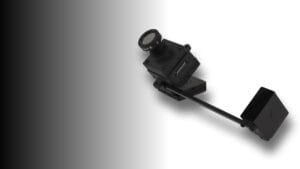
Systems that support multiple cameras, such as Smart Eye Pro, offer broader facial coverage. This helps maintain stable tracking even when participants move, shift posture, or fall outside typical face geometry. Built-in validation tools make it easy to check calibration mid-session, and adaptive calibration modes help simplify setup across varied participant groups.
In research environments where participant diversity is high, or where you can’t afford to lose time or data, choosing a system designed for flexibility can pretty much make or break the study.
Accounting for participant variation can feel like one more thing to worry about – especially when you’re already juggling hardware, experimental design, and scheduling. It’s tempting to treat it as a secondary concern. But when the data starts coming in, that oversight becomes hard to ignore.
It’s one thing to design a study that works on paper. It’s another to make sure it works with the people in the room. If your system only holds up under ideal conditions, your results won’t go far. To produce research that reflects the real world, you need tools and setups that can handle real-world variation.
Planning a study with a diverse participant group?
Get in touch to learn how Smart Eye Pro supports stable tracking across a wide range of faces, eyes, and behaviors.