EN


In-cabin cameras are the eyes of modern driver and cabin monitoring systems. They track where the driver is looking, how alert they are, and what’s happening in the cabin. But those insights only work if the system is able to see the scene exactly as it is.
In real vehicles, nothing stays perfectly still. Steering wheels move, mirrors are adjusted, and dashboards vibrate. Even small changes like these can throw off a camera’s alignment and affect how well the system interprets what it sees.
To stay reliable, the system needs to know exactly where its cameras are and how they’re aligned at all times.That continuous adjustment — sometimes referred to as auto calibration or automatic camera calibration — is known as Dynamic Camera Pose Calibration, or DCPC.
DCPC, or auto calibration, is a software function that helps the system understand exactly where the camera is placed and how it’s angled inside the vehicle. It does this by analyzing visual cues and known reference points in the cabin, comparing what the camera sees with what it expects to see. In doing so, it can detect small changes in position or rotation and update its internal model automatically and continuously.
This becomes especially important when cameras are mounted in components that can move, like the steering column or rear-view mirror. These placements can give a better view of the driver and passengers, but they also mean the camera’s perspective can change every time someone adjusts the mirror or steering wheel.
With DCPC, the system adapts to those movements in real time. Whether the camera shifts slightly or the cabin layout differs between vehicle models, it continuously fine-tunes its understanding of the environment so that gaze, head, and body tracking stay consistent and precise, even when cameras move or cabin layouts vary.
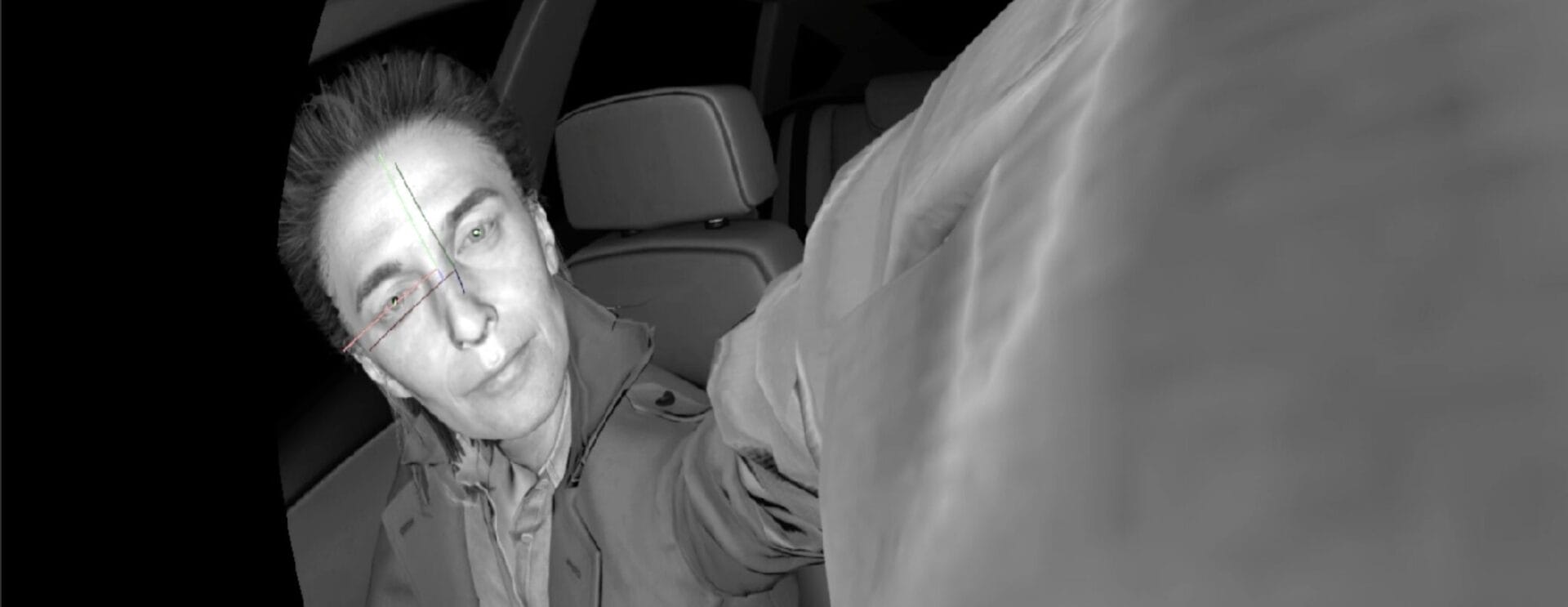
This video, generated in Smart Eye’s Synthetic Data Generation Tool, gives you an idea of how DCPC works with a camera mounted in a rear-view mirror. As the driver adjusts the rear-view mirror, the camera immediately and automatically recalibrates, making sure the driver’s gaze stays accurately tracked.
Accurate camera calibration is key for keeping in-cabin sensing systems trustworthy. DCPC continuously maintains that accuracy and keeps tracking precise across different vehicles and throughout years of use.
For vehicle manufacturers, this translates into several advantages:
• Consistent accuracy: Stable tracking of eyes, head, and body over time and across conditions.
• Simpler installation: Cameras can be mounted with wider tolerances, reducing the need for manual recalibration.
• Scalability: Works across multiple vehicle platforms and interior designs.
• Future readiness: Supports technologies such as under-display cameras and multi-seat sensing setups.
Even small camera misalignments can lead to noticeable drops in performance. When calibration happens continuously in the background, the system stays accurate without any manual intervention.
In newer vehicles, many functions that were once fixed in hardware are now managed through software — including calibration. Instead of being tied to a single vehicle configuration, calibration needs to adapt as systems evolve through design updates, over-the-air improvements, or new sensor placements.
Dynamic Camera Pose Calibration (DCPC) is an important part of this development. By managing camera alignment in software, it supports the flexibility that software-defined vehicles rely on. This ensures that sensing remains accurate even as hardware and architectures change.