/ Next post
8 April, 2026


Efforts to stop drunk driving have long focused on changing individual behavior: through better education, harsher penalties, or more sobriety checkpoints. But even as social attitudes change and enforcement tightens, thousands still die each year in alcohol-related crashes.
So what if the car itself could help stop it from happening?
That’s the premise behind a growing interest in in-vehicle technology that can detect driver intoxication before it becomes deadly. Combined with new policy and stricter safety ratings, the hope is that these tools could intervene earlier and prevent many of the crashes related to impaired driving.
To better understand where real progress might come from — whether through better policy, smarter vehicles, or cultural change — we gathered perspectives from people working at the intersection of research, advocacy, regulation, and safety.

The core strategies to prevent intoxicated driving — from breathalyzers to roadside checks — haven’t changed much in decades. And while the dangers of drunk driving are well understood, the number of lives lost each year remains stubbornly high. So why is progress still so slow?
For Christer Ahlström, Senior Researcher at the Swedish National Road and Transport Research Institute (VTI), the root issue is cultural.
“The most urgent challenge is changing societal attitudes and behaviours towards drunk driving,” he says. “Here in Sweden, we’ve made significant progress by managing to establish norms against drunk driving.”
Sweden’s 0.2‰ legal limit is among the lowest in the world. But Ahlström argues that regulation alone isn’t enough. It must be coupled with robust enforcement and the establishment of strong social norms against drunk driving.
“Despite strict laws and enforcement, many people still underestimate the dangers of driving under the influence. Public awareness campaigns, education, and community-based interventions are crucial to shift perceptions and encourage responsible behaviour.”
That gap between understanding and taking action is something Svitlana Finér, Research Engineer at Smart Eye, sees firsthand in her work developing intoxication detection technology. The problem, she explains, isn’t always awareness.
“The more someone wants to get from point A to point B, the more they’ll ignore safety concerns — especially when they’re intoxicated,” she says. “They’re not thinking straight, so even if they know it’s unsafe, they may get behind the wheel.”

But while changing behavior is one part of the equation, others argue that more effective deterrents — from enforcement to in-vehicle tech — are just as crucial. Stephanie Manning, Chief Government Affairs Officer at Mothers Against Drunk Driving (MADD), sees consistent law enforcement as one of the most effective deterrents.
“High-visibility law enforcement catches people who choose to drive while illegally impaired,” she says. “But it also deters would-be impaired drivers by sending a message that if they drive drunk, they will be caught. Ultimately, anti-drunk driving technology is the solution to eliminating this crime.”
Enforcement can stop drunk driving in the moment, but it doesn’t stop someone from getting behind the wheel in the first place. Rikard Fredriksson, Senior Advisor at the Swedish Transport Administration and Euro NCAP board member, wants to see efforts to reduce the number of people who drive drunk altogether:
“The most urgent challenge we need to address is finding technology that can reliably and cost-effectively detect and prevent drunk driving,” he says. “That is why we from Sweden proposed awarding such technology for the current Euro NCAP roadmap, and subsequently it was introduced in a first step in the 2026 update on Driver monitoring, under the category of Driver Engagement.”
The idea is to use existing technology, such as driver monitoring cameras, and add algorithms to detect intoxication in real time based on the driver’s behavior. Software developers and researchers are already working on these new algorithms, with the goal of making them reliable enough for large-scale deployment.
Developing that kind of technology, however, comes with its own set of challenges — as Svitlana Finér knows from experience. Unlike drowsiness or distraction — which can be studied in relatively realistic ways — intoxication can’t legally be tested on public roads.
“That’s why we rely on carefully controlled test track studies,” says Finér. “The key is making sure those scenarios reflect real-world behavior as closely as possible.”
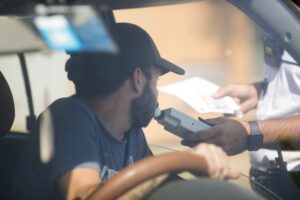
Drunk driving is a human problem. But increasingly, the solution may be a technical one.
While traditional enforcement steps in after someone has already made a dangerous decision, in-vehicle systems offer something else: the chance to catch impaired driving earlier — potentially before the car even moves.
Christer Ahlström sees the biggest benefit of in-vehicle systems in stopping drivers who choose convenience over caution. Tools like driver monitoring systems can flag signs of impairment early, alert the driver, or activate other safety features to reduce risk behind the wheel.
Even if the technology isn’t perfect, he says, it could still prevent many from making a decision they already know is wrong:
“There will always be ways to cheat an in-vehicle system,” he says. “But the main advantage is preventing people who act out of habit or convenience — those who know better but drive drunk anyway.”
Ahlström notes that while more complex scenarios — like switching drivers mid-trip — are harder to manage, most drunk driving doesn’t fall into that category. For many, the problem is routine, not premeditated.
“In-vehicle technology will be most important in scenarios where interlocks are not implemented on a large scale,” he adds.
In other words, it’s everyday personal driving — not the kind monitored by courts or employers — where the greatest number of lives could be saved.
Svitlana Finér agrees. But she also believes the greatest value might come from the mere presence of detection systems — just like the threat of roadside checks or police patrols.
“If people know the car will detect intoxication,” she says, “they’ll think twice before getting behind the wheel.”
Rikard Fredriksson also sees promise in pairing different technologies to maximize their effect.
“I hope a combination of alco-lock and driver monitoring DUI technology can make a true benefit to minimize drunk driving or the effects thereof,” he says.
For Fredriksson, the priority is straightforward: a system that can detect impairment and intervene effectively — whether that means preventing the drive altogether or supporting safer vehicle behavior once on the road.
Stephanie Manning sees even broader potential. She points to in-vehicle technology as the most direct path to preventing drunk driving on a large scale.
“Anti-drunk driving technology will save more than 10,000 lives every year when fully implemented into all new vehicles – eliminating nearly all drunk driving deaths and injuries.”
She also sees a unique opportunity in reaching younger drivers and their families — people already accustomed to technology making decisions for them:
“This will likely be of special interest to parents of young drivers… a generation that has grown up with incredible technological advances and could appreciate livesaving technology that prevents impaired driving.”
Intoxication detection systems have moved well beyond the concept stage. Real-world drunk driving research is studying everything from eye movements to physiological signals, with the goal of identifying intoxication reliably and non-invasively.
But translating technical feasibility into real-world impact is a different challenge entirely. It’s not just about what the systems can do, but about how, where, and whether they’ll actually be used.
Rikard Fredriksson, who has been involved in shaping Euro NCAP’s occupant monitoring protocols, agrees that detection systems are only as effective as the scale at which they’re adopted. While Euro NCAP already awards points for impairment detection, he hopes to see higher weight given as the technology matures.
“We hope it will evolve to have higher detection capability and reliability,” he says.
Ensuring that level of reliability is partly up to software developers. Svitlana Finér, who develops these systems at Smart Eye, explains one of the toughest parts of developing the algorithms is accounting for individual differences in how people behave when impaired.
“There’s a lot of variation in how people behave when drunk,” she says. “Some fall asleep, others get agitated. That’s why you can’t rely on a single signal — the more inputs you have, the more stable your system will be.”
Still, the speed and scale of adoption won’t come down to the technology alone. As Christer Ahlström points out:
“Prohibiting unfit drivers from driving will not be solved or initiated by vehicle manufacturers. Politicians will have to set the agenda.”
And there are signs that they are. Legislative efforts like the HALT Drunk Driving Act are already calling for these systems to become standard in new vehicles within just a few years.
Stephanie Manning sees this as a turning point.
“Anti-drunk driving technology will save more than 10,000 lives every year when fully implemented into all new vehicles,” she says. “This is the most promising opportunity we’ve had in decades — and we need to act on it.”
