EN


Some research labs are sleek and climate-controlled. Others sound like a jet engine, shake like a rollercoaster, and blind your cameras every time the sun shifts.
If you’re running studies in simulators, cockpits, or outdoor vehicles, chances are you’ve already asked yourself: Can eye tracking really work under these conditions, or are we just pretending it can?
Let’s look at what happens when you take eye tracking off the spec sheet and into the real world – and what it takes to keep it working when conditions are anything but controlled.
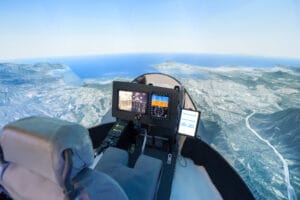
When we talk about extreme environments, we don’t necessarily mean once-in-a-lifetime test flights or research done on the edge of the Arctic. We mean any setup that tests the limits of what an eye tracking system can handle, often by design.
That could be:
• Constant vibration, like in race cars or aircraft simulators
• Rapid lighting shifts, like entering tunnels or driving through changing daylight
• Unstable or constrained mounting, like in multi-camera rigs or cramped cockpits
These setups are a normal part of studying real-world behavior, especially in applied research fields like aviation, automotive, or human factors. And while the environments themselves may vary, the underlying challenge is the same: conditions that make stable, accurate tracking harder to achieve.
It doesn’t take extreme motion or pitch-black lighting to cause trouble, either. Even moderate levels of instability – a wobbly seat, uneven light, subtle head movement – can introduce errors that don’t show up until the data’s already been collected. That makes it all the more important to understand what your system is up against, and how to prepare for it.
In extreme conditions, the factors that throw off tracking rarely act alone. Vibration can loosen a hardware mount. Or sudden sunlight might make a participant turn their head, breaking the system’s line of sight.
Each of these can disrupt the visual link between system and subject.
Over time, a few failure points tend to show up again and again:
• Loss of calibration from vibration or flex
In environments like simulators or test vehicles, frequent vibration and structural flex can shift camera alignment or interfere with pupil detection, causing calibration to drift or fail entirely.
• Infrared interference or saturation
Sunlight can sometimes overwhelm infrared illumination, especially in vehicles or outdoor labs. Reflections from surfaces inside a cockpit – even polished dashboards – can create noisy data or throw off gaze estimation.
• Dropped frames from unpredictable movement
When participants move freely or head position isn’t well constrained, tracking often degrades or becomes erratic. If the system isn’t fast or robust enough, it may lose track of the eyes entirely, especially under variable lighting.
• Synchronization issues in complex setups
Multi-camera or multi-sensor systems offer better coverage, but only if all components stay precisely synchronized. In more complex rigs, even slight timing mismatches between devices can lead to jittery or mismatched data streams.
You can’t treat your setup like a museum exhibit: untouched, perfectly staged, and sealed off from real-world interference. In many cases, real-world interference is the whole point.
What you can do instead is plan for a little chaos. That way, your setup stands a better chance of holding up when the going gets rough.
• Start with the mount. If your system’s mounted to something that rattles, flexes, or drifts, you’re already in trouble. Reinforce the rig. Add damping. Treat small vibrations like the data killers they can be.
• Expect lighting to turn on you. Sunlight and reflective surfaces don’t just mess with contrast, they can saturate IR sensors completely. Filters help, but so does testing your setup at the worst time of day, not the best.
• Add redundancy where it counts. A second camera angle won’t save every session, but it might save the one where your main view gets blocked for two critical seconds. In dynamic environments, fail-safes matter.
• Make validation part of the session. If you’re only checking calibration at the beginning, you’re gambling. Check mid-way, and check often. Don’t assume good data unless you’ve seen proof.
• Tune like it’s going to get weird. Harsh shadows? Strobing sunlight? Constant motion? Don’t calibrate for the ideal, calibrate for what your environment is likely to throw at you.
Designing an eye tracking system for extreme environments means planning for all the ways things can go wrong – then building in ways to recover.
You start with a wide tracking range, so the system doesn’t lose track of the eyes the moment someone shifts in their seat. You support multiple cameras, so if one loses sight, another can pick it up. You make sure everything stays in sync down to the frame, because even tiny timing mismatches can throw off the data. And you give researchers the tools to validate and recalibrate mid-session, without derailing the session.
Smart Eye Pro was built with those goals in mind. In high-motion or high-complexity setups, adaptability is what keeps your session usable.
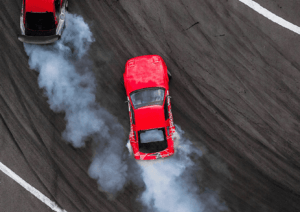
So what does it actually take for an eye tracking system to hold up in extreme environments? One way to find out is to mount it in a race car, on a desert track, in 48°C heat – and put it through a full day of performance driving.
That’s exactly what Smart Eye did in a pilot study at the Bondurant High Performance Driving School in Chandler, Arizona. The goal was to capture driver gaze data during high-speed laps, while pairing it with vehicle telemetry and emotional response data.
The setup was tested under conditions that don’t leave much room for error:
• Mounting constraints meant no drilling or permanent fixtures. Instead, Smart Eye Pro’s compact size and modular hardware made it possible to mount cameras securely with only two-sided tape.
• Lighting was wildly uneven, with bright desert sun outside and shaded cabin interiors inside. Even with this extreme contrast, the system was able to maintain coverage with only minor adjustments mid-study.
• Vibration levels were far beyond typical test conditions. Yet Smart Eye Pro’s calibration held steady, even with shifting posture, head movement, and a flexible mount.
• Outside temperatures reached 119°F (48°C) – Despite the desert heat, system components stayed well within operational range inside the vehicle, demonstrating thermal reliability in real-world conditions.
Ultimately, the test showed that with the right system design – with flexible mounting, multi-camera setups, built-in calibration stability – eye tracking can deliver reliable results even under full-throttle conditions.
For a closer look at how the setup was designed, and how it held up, check out the full Bondurant blog.