EN


During a simulator session, a pilot reacts a few seconds too late to a warning. Everything else in the procedure looks correct, but the delay raises questions. Was it a missed cue? Too much workload? Or simply a lapse in awareness?
With eye tracking, instructors no longer have to guess.
Attention data reveals when a trainee’s focus narrows and what they were actually attending to at the time. This context helps instructors pinpoint the cause of an error and tailor their feedback right away.
Rather than adding another dashboard or set of charts, eye tracking gives instructors the ability to see how decisions are made in real time. Armed with this information, they can focus on actually improving performance, not just interpreting it.
Eye tracking data turns perception into something you can measure. Each fixation and scan path is recorded and time-stamped in sync with simulator events, creating a detailed record of what the trainee looked at, when, and for how long.
For instructors, that context translates into immediate value:
• Faster feedback: Performance gaps become visible as they happen, helping instructors respond immediately or plan targeted adjustments for the next session.
• Clearer evaluation: Eye tracking confirms whether missed actions stemmed from distraction, overload, or misunderstanding.
• More consistent scoring: Objective data backs up instructor judgment, reducing the variability that often occurs across sessions or evaluators.
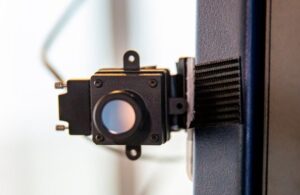
Once eye tracking data is synchronized with simulator events, it can be transformed into structured indicators — measurable patterns in awareness and workload that can be observed and compared across sessions. Instead of broad impressions, instructors can work with specific evidence of scanning discipline, missed cues, or overload.
| Competency | Attention Indicator | Instructor Insight |
|---|---|---|
| Situational awareness | Sequence and frequency of scanning across instruments | Confirms whether attention followed expected scanning routines during key moments |
| Monitoring discipline | Ratio of fixations on high-priority vs. peripheral areas | Shows how effectively the trainee balanced focus between primary and secondary tasks |
| Workload management | Variations in fixation duration and pupil dilation over time | Identifies periods of cognitive strain or high information load that affect performance |
| Decision-making under pressure | Time between cue detection and corrective action | Indicates whether the trainee recognized information early enough to respond effectively |
These indicators aren’t meant to replace instructor judgment, but they can help reinforce it. When visual attention narrows or delays appear, instructors can pinpoint when it happened and why, linking gaze behavior directly to performance outcomes.
In evidence- and competency-based training frameworks, this makes feedback both measurable and repeatable. Instructors gain a common language for describing performance, and trainees see concrete evidence of how their attention patterns affect results.
One of the clearest demonstrations of how eye tracking supports instructor feedback comes from the Royal Netherlands Aerospace Centre (NLR). During air traffic control training, instructors wanted to make cognitive skills like situational awareness and workload management visible, which traditional simulator metrics couldn’t capture.
To do this, NLR used Smart Eye Pro with a multi-camera setup around the radar display. The system captured gaze and pupil data and synchronized it with simulator events, such as:
• Flight positions and traffic types
• Communication logs
• Controller actions and timing
This synchronization made it possible to measure key cognitive processes like perception, anticipation, workload, and decision-making without altering normal training routines.
The results gave instructors a clear view of how trainees monitored traffic, anticipated conflicts, and managed workload. Demonstrations showed measurable differences between novice and experienced controllers, helping instructors ground feedback in observable, time-stamped data rather than subjective impressions.
As NLR described it, the system made cognitive skills visible to instructors and provided valuable additional parameters for their research.
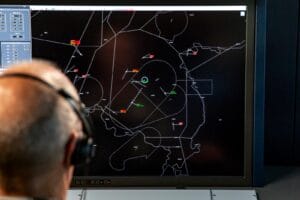
Eye tracking data becomes most powerful when it connects directly with existing simulator tools. Through Smart Eye’s SDK and API connections, gaze and pupil data are synchronized with simulator events and other sensor inputs on a shared time base.
This synchronization allows attention data to be displayed in familiar instructor interfaces. For example:
• A timeline showing when and where the operator’s focus shifted
• A breakdown of how much time was spent monitoring key instruments or zones
• Combined playback of simulator and gaze data for post-session debriefs
Because the integration runs in parallel with existing systems, nothing needs to be replaced or redesigned. It simply adds a behavioral layer to the data instructors already use and makes it easier to see how awareness and decision-making evolved in real time.
Integrating eye tracking into simulator training changes how instructors work. Not by adding more data, but by making existing data easier to understand. When gaze information is synchronized with simulator events, instructors can see what the trainee was focused on at each moment and base their feedback on clear evidence rather than assumptions.
That shared view improves consistency between sessions and across instructors. It makes evaluations easier to compare, debriefs faster to prepare, and long-term progress simpler to track. Over time, eye tracking data blends into daily training workflows, used naturally alongside other simulator metrics.
Want to see how eye tracking can fit into your training setup? Get in touch with Smart Eye to explore how attention data can strengthen your simulator programs and improve operator performance.